Playing loud music after 11pm isn’t automatically illegal in the UK. There’s no single nationwide law that requires everyone to turn their speakers off at eleven o’clock — but that doesn’t mean anything goes. Councils have the power to investigate noise that amounts to a statutory nuisance at any time of day or night, and between 11pm and 7am they have additional powers to issue warning notices when residential noise exceeds permitted night-time levels. So while the 11pm “rule” many people reference isn’t quite the hard legal cut-off it’s often made out to be, that period does carry extra weight.
This guide draws on GOV.UK guidance on noise nuisances to explain what councils can actually do if someone complains. It then looks at how the situation differs between licensed venues and house parties, offers practical steps for keeping noise down, and covers options — including silent disco — for keeping a party going later without disturbing the neighbours.
The short answer
There is no universal law in the UK that says you must stop playing loud music at 11pm. Councils can investigate noise that amounts to a statutory nuisance at any time of day or night. But the period between 11pm and 7am carries additional weight — during those hours, councils in England have expedited powers to tackle residential noise. The practical takeaway: be considerate, expect greater scrutiny once the clock passes eleven, and consider alternatives such as silent disco if you want the party to carry on without the risk of a formal complaint.
What the law says — statutory nuisance and night-time powers
The legal basis for council action on noise is the concept of statutory nuisance, set out in the Environmental Protection Act 1990. In plain terms, noise becomes a statutory nuisance when it unreasonably interferes with someone’s ability to use or enjoy their property, or when it is harmful to health. There’s no precise decibel level written into the law — it’s a judgement based on whether the noise is genuinely unreasonable in context.
A garden party on a summer afternoon is unlikely to meet that threshold, even if it’s fairly loud. A PA system thumping bass through a terraced wall at 1am is a different matter entirely.
Why 11pm to 7am matters more
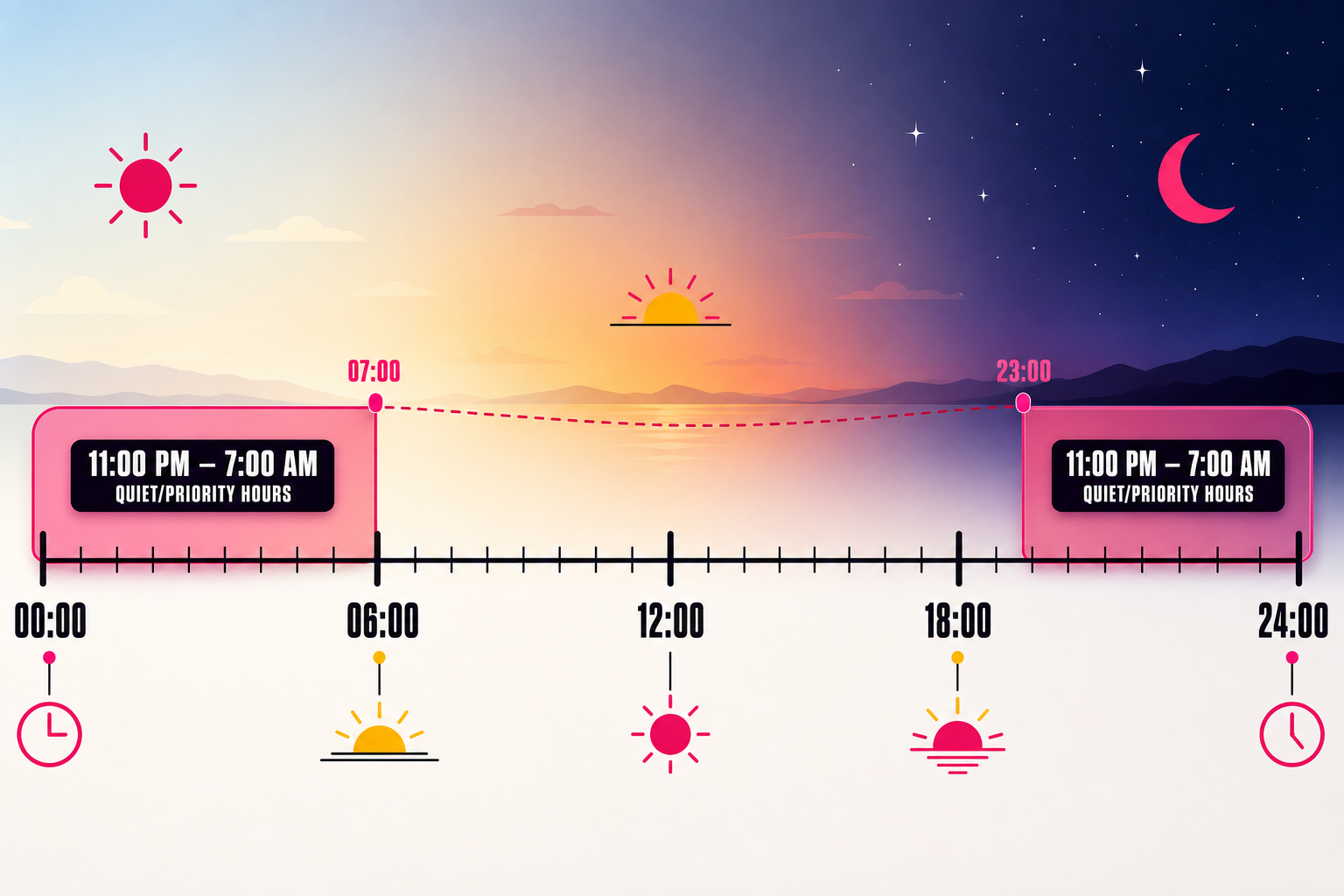
Between 11pm and 7am, councils in England have an additional, faster tool available for dealing with residential noise. Under the Noise Act 1996, councils can issue noise at night warning notices in response to noise from a dwelling during this period — without needing to complete the full statutory nuisance process first. As set out in GOV.UK: Noise nuisances — how councils deal with complaints, this gives them a quicker route to intervene when residential noise is causing a problem at night.
If the noise continues after a warning notice has been served, the council can issue a formal abatement notice. Ignoring that can result in a fixed penalty fine — currently £100, reduced to £50 if paid promptly — or, for persistent offenders, prosecution.
It’s worth being clear about scope: these specific night-time warning notice powers apply to noise coming from residential dwellings. Noise from licensed commercial venues is dealt with under the broader statutory nuisance framework and through licensing conditions, rather than this particular route.
The key point is that the 11pm threshold isn’t a magic switch that makes music automatically illegal. A quiet acoustic playlist drifting from an open window at midnight is unlikely to trigger the same response as repeated late-night parties with a loud subwoofer disturbing an entire street. But playing loud music at night does attract meaningfully more scrutiny, and councils have real tools to act on it.
How councils investigate complaints — measurements, warnings and penalties
When a neighbour makes a noise complaint about loud music, it doesn’t automatically result in someone turning up at your door within minutes. The process tends to be staged.
- Initial contact — The neighbour contacts the council, usually by phone or online. The council logs the complaint and may ask the complainant to keep a noise diary, noting dates, times and descriptions of the noise.
- Assessment — An environmental health officer reviews the complaint and decides whether it warrants further investigation. Not every complaint leads to a site visit.
- Site visit and measurements — If the council decides to investigate, an officer may visit — including late at night — to assess the noise directly. They can take decibel readings outside the complainant’s property to build an evidence base.
- Warning notice or abatement notice — Depending on what they find, the council can issue a warning notice or a formal abatement notice requiring the noise to stop or reduce. Full details are on GOV.UK.
- Further action — Ignoring an abatement notice can result in a fixed penalty fine, prosecution, or in serious cases, equipment being seized.
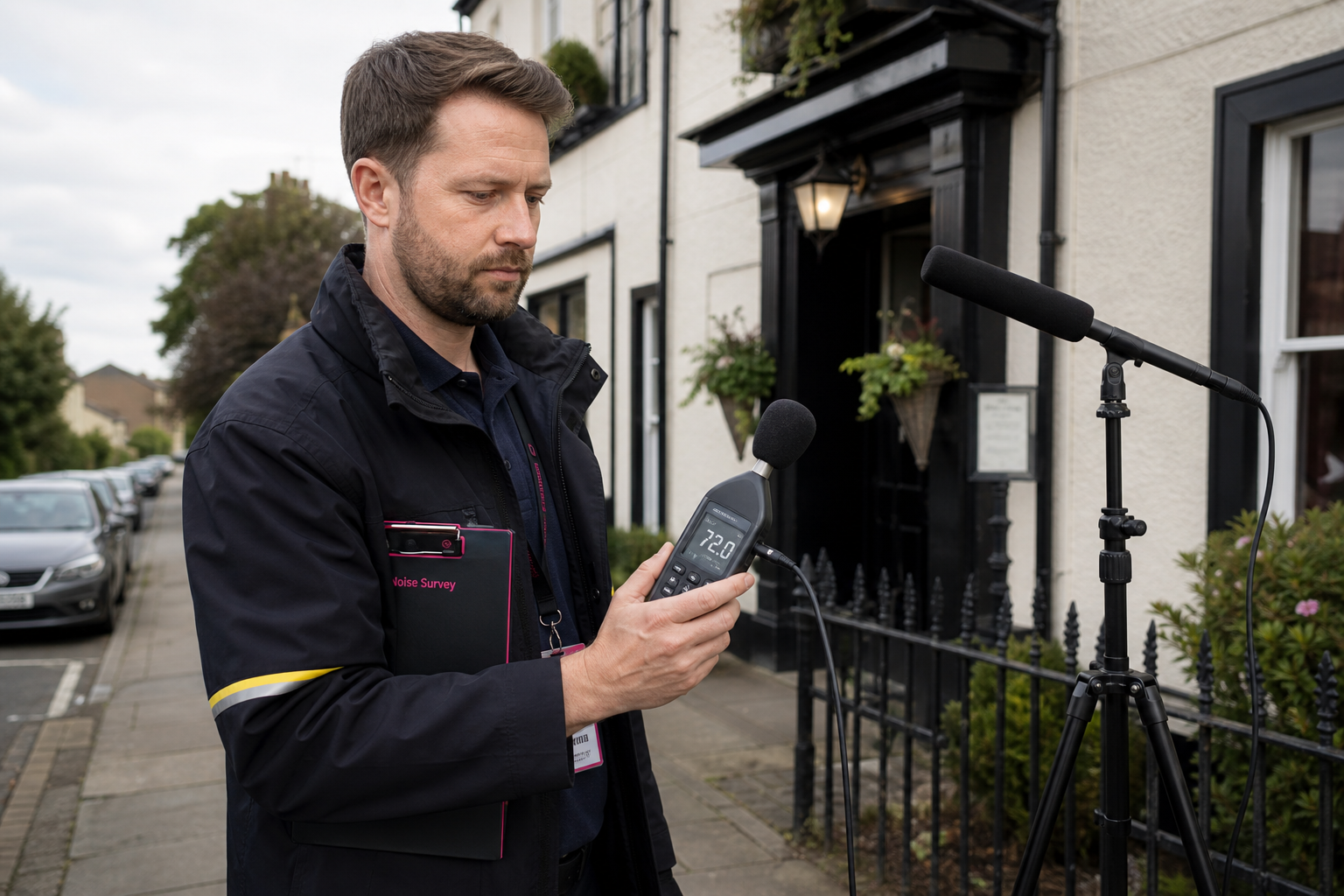
Officers do visit, and they do measure. Noise complaints and council powers aren’t just words on a page.
A few practical points if this situation arises:
- Cooperate with officers calmly. Arguing rarely helps and can make things worse.
- If you believe a complaint is unfair, keep your own records: timestamps, notes about speaker placement, and details of the event.
- Reduce the noise as soon as you become aware of a concern, rather than waiting for formal action. A complaint that resolves quickly is far less likely to escalate.
Licensed venues vs house parties — why the rules feel different
If you’ve ever wondered why a nightclub can play loud music on a Saturday night while a house party two streets away gets a noise complaint, the answer comes down to infrastructure and licensing.
Licensed venues — wedding barns, function rooms, dedicated events spaces — typically operate under a premises licence that sets out exactly what they can do and when. Those licences often include specific conditions around music hours, amplified sound and acceptable noise levels at the boundary of the property. The venue has agreed to those conditions as part of getting and keeping its licence.
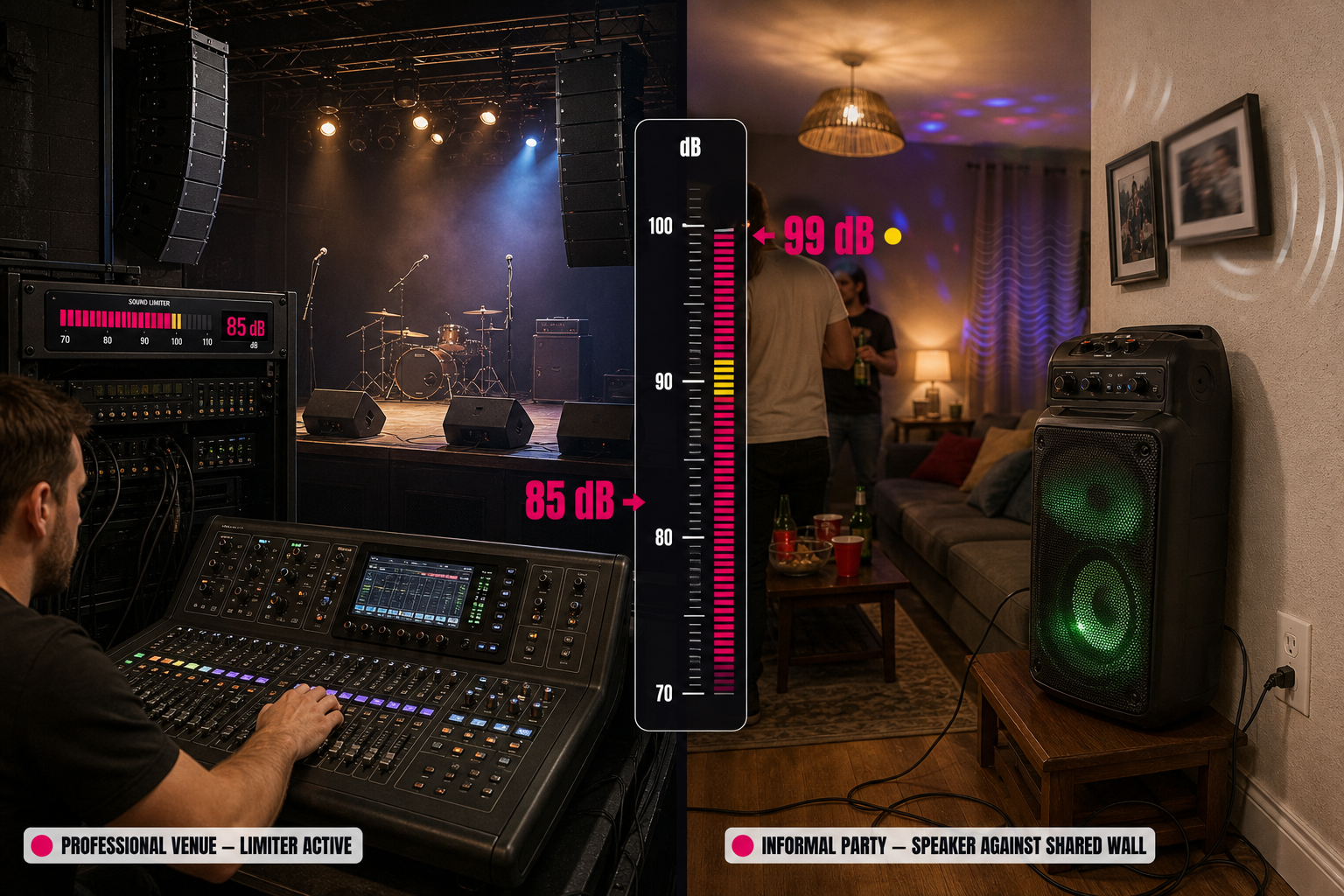
Many venues in residential areas also install a sound limiter. This monitors the PA output and will either warn when levels are getting too high, or physically cut the power to the system if a set threshold is exceeded. It’s a reliable way to keep noise within licensed limits.
House parties are a completely different situation. There’s no licence, no limiter and no trained staff monitoring levels. A speaker that sounds perfectly reasonable when you’re standing in a room full of guests can travel easily through shared walls to a neighbour trying to sleep. The physical gap between your living room and next door can be just a few centimetres of brickwork.
If you want to play loud music late on weekends or into the early hours, a properly licensed venue is generally a far simpler option than trying to achieve the same at home. For those planning a late-night party at home, silent disco hire offers a practical alternative — more on that shortly.
Practical tips to reduce noise complaints at a house party
The most effective approach combines communication with neighbours before the event and a few small technical adjustments on the night. Neither requires much effort, but together they make a real difference.
Talk to your neighbours beforehand
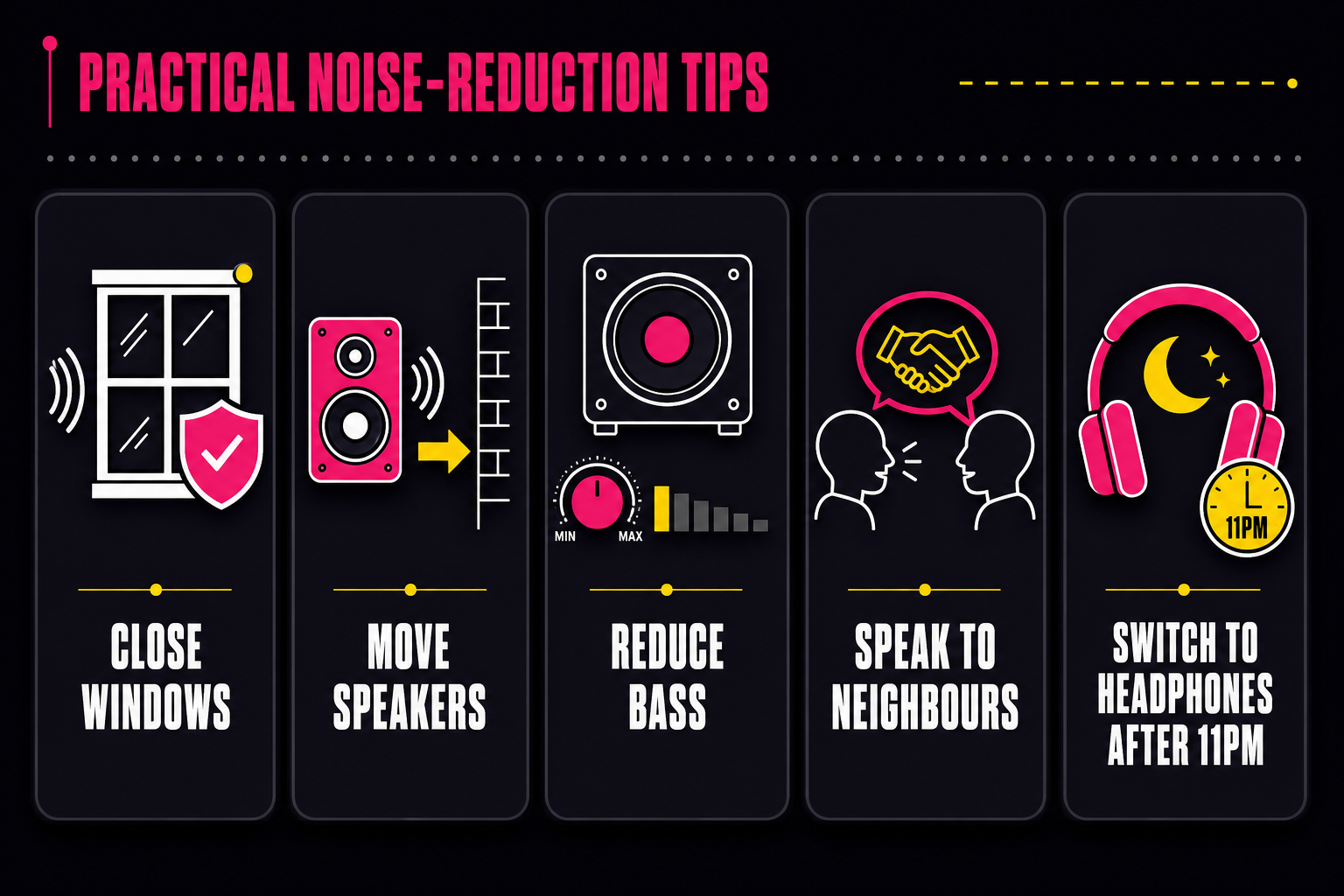
Speaking to neighbours before a party goes a long way. Let them know what you’re planning, roughly when the louder part will wind down, and how to reach you directly if there’s a problem. If it suits, invite them. A neighbour who knows about the party in advance — and has your number — is far less likely to call the council than one who’s been woken up with no warning.
Manage the sound setup
- Keep speakers away from shared walls. Bass travels through walls easily, so positioning speakers towards the centre of the room rather than flush against a party wall makes a noticeable difference.
- Reduce the bass as the evening progresses. Low frequencies carry furthest. Turning down the bass EQ after 10pm or 11pm can cut the noise that reaches neighbours without ruining the listening experience inside.
- Close windows and doors, particularly once it gets late. An open back door can project music across a garden and into several neighbouring properties at once.
- Use soft furnishings. Rugs, sofas and curtains absorb sound. A room stripped back for dancing is more echoey; leaving some soft furnishings in place helps keep levels manageable.
Turn it down gradually
Progressive volume reduction is far better than a sudden stop. Bringing the music down slowly as the night goes on feels natural to guests and significantly reduces the risk of complaints.
Don’t assume rural means no rules
If you’re considering hosting somewhere outside the city because you assume it gives more freedom, be cautious. Rural areas fall under the same statutory nuisance framework, and sound can travel further with fewer buildings to absorb it.
Switch to headphones
Switching to silent disco hire after 11pm is one of the simplest ways to remove the PA as a noise source entirely. Guests keep dancing; the neighbours hear nothing. If you’d like to talk through options for your event, get in touch.
Alternatives — hiring a venue or using a private rural property
Hiring a venue is generally the most reliable way to play loud music late, but only if you go in with the right questions. A licensed events venue brings genuine advantages: staff who understand noise management, a premises licence with clearly defined hours, and — in many cases — established relationships with local councils and neighbours.
Before you book, ask:
- What are the licensed hours for amplified music? Many venues have a music curfew that may be earlier than you’d expect — midnight is common, sometimes earlier on Sundays.
- Is there a sound limiter, and what level is it set at? This affects how loud your music can realistically be.
- How close are neighbouring properties? Even rural venues can have noise conditions attached to their licence if there are dwellings nearby.
Private rural properties — barns, farmhouses, holiday lets — are popular for parties, and isolation can reduce the immediate risk of neighbour complaints. But don’t assume the countryside removes all restrictions. Many rural accommodation providers explicitly prohibit events or loud music in their terms, and local councils still have jurisdiction regardless of location.
If a venue’s curfew or sound limiter limits your plans, silent disco hire is worth considering as a way to keep the music going without exceeding noise thresholds.
Silent disco: how to keep playing loud music after 11pm without the PA
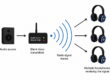
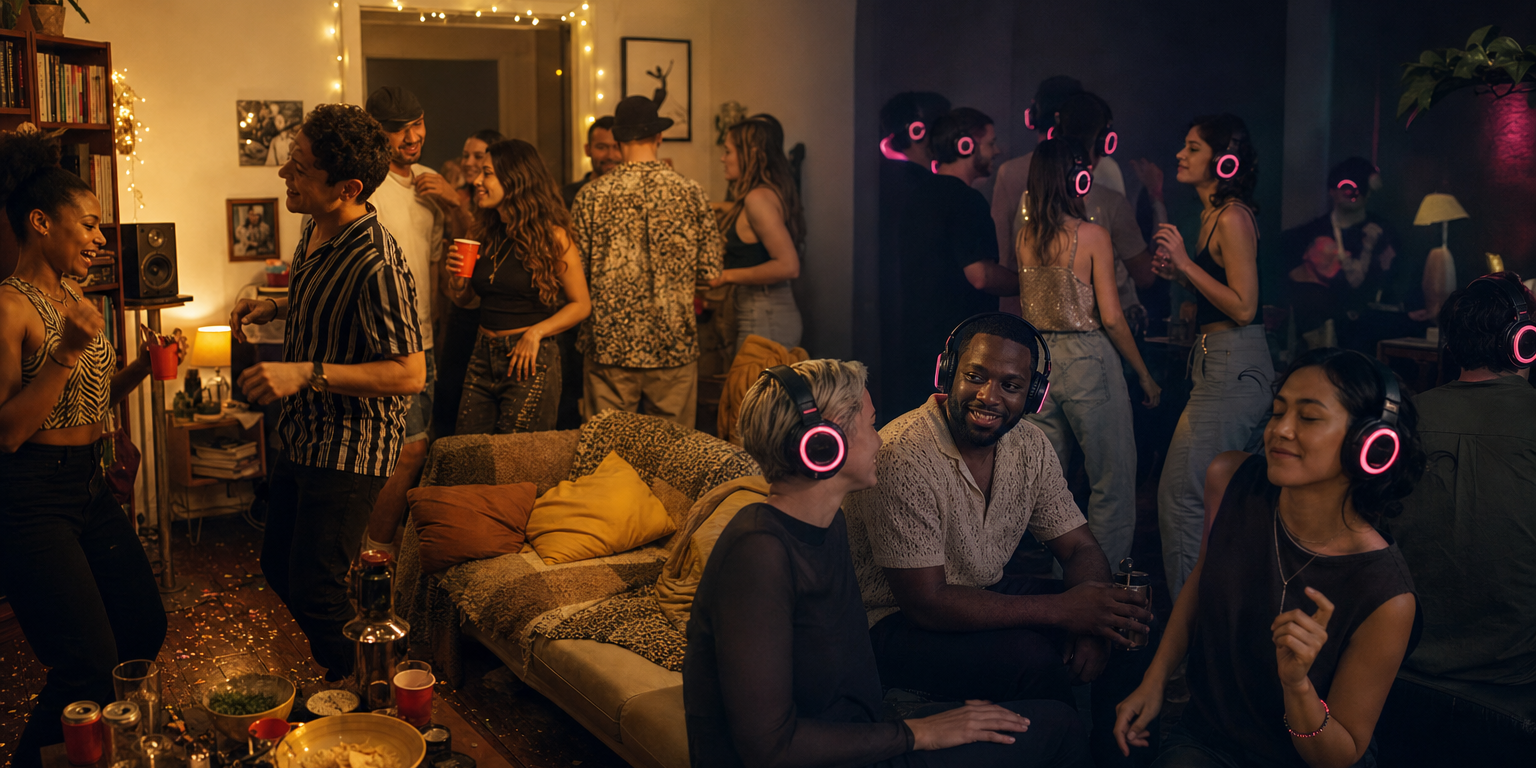
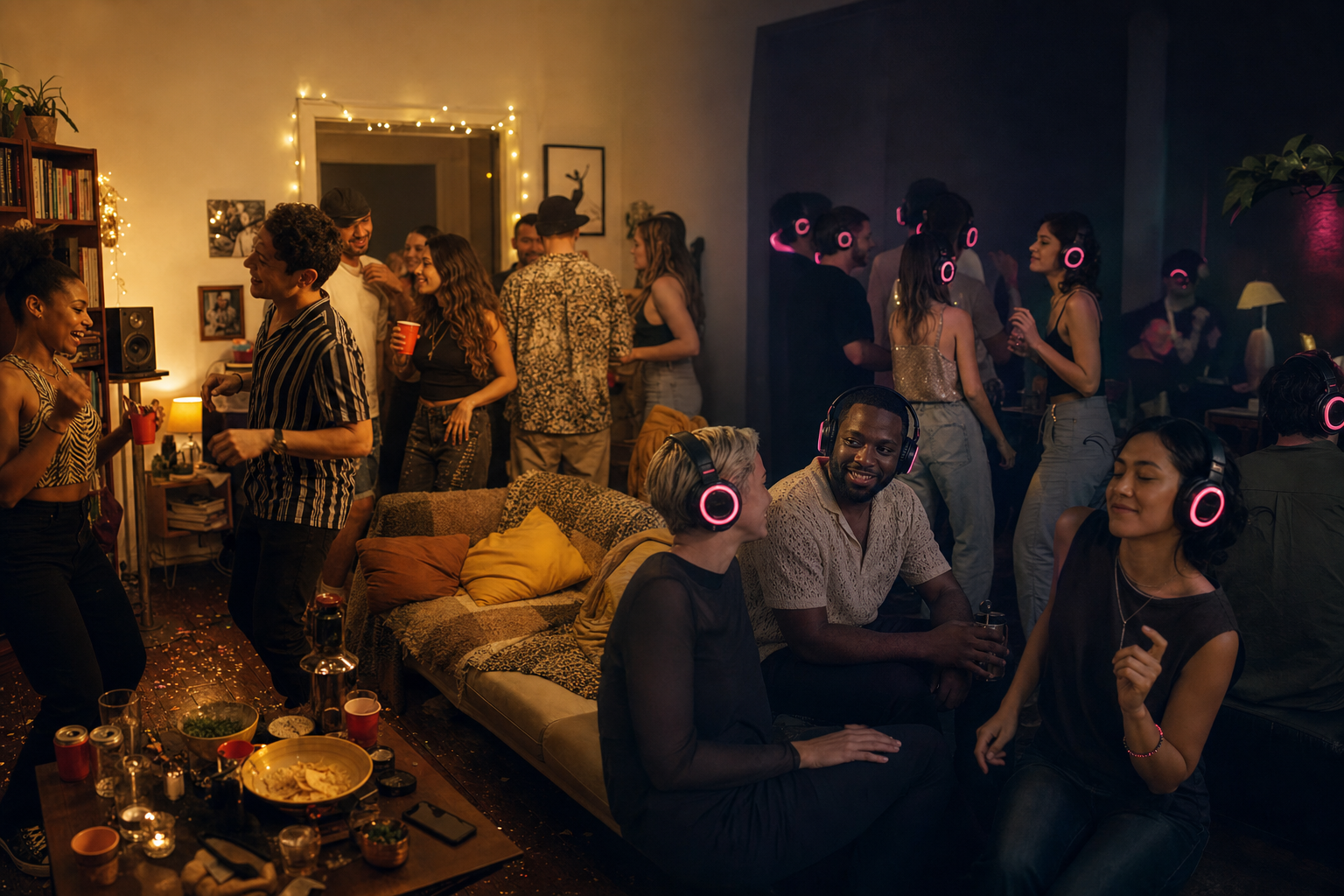
A silent disco is one of the most practical answers to the question of how late you can play loud music — because it sidesteps the problem entirely. Instead of sound coming from loudspeakers, guests wear wireless headphones that receive the music directly. From outside the room or garden, there’s very little to hear. Inside, guests can listen at whatever volume they choose.
How a hybrid approach works
- Run a normal PA system for the earlier part of the evening — dinner, dancing, the main event.
- As 11pm approaches, distribute the silent disco headphones to guests.
- Switch the music source to the wireless transmitter and fade out the PA.
- The party continues; the external noise drops significantly.
This hybrid approach works well for home parties and events. It preserves the energy of the evening while removing the PA as the primary noise source — which is usually what triggers complaints in the first place.

Most silent disco setups allow multiple channels, so different music can play simultaneously and guests choose what they listen to via a switch on the headphones. It adds an element of novelty that guests tend to enjoy.
One honest caveat: a silent disco isn’t completely silent from the outside. Guests’ voices, laughter and dancing are still audible — it’s the amplified music that’s removed, not all human sound. That’s a meaningful improvement for neighbours, but it’s worth setting expectations accordingly.
Browse our silent disco hire services for details, or contact us for booking and advice if you’d like help working out what you need for your event.
Quick checklist and sample timeline for a late-night party
Pre-party checklist
- Speak to immediate neighbours; give them a specific time when loud music will stop
- Share your mobile number so they can reach you directly rather than calling the council
- Plan taxi and car arrangements to reduce noise outside later in the evening
- Set up silent disco hire headphones ready to switch over at 11pm
Sample timeline
- 6–9pm — Guests arrive; background music at a sociable level
- 9–11pm — Main dancing; PA at full volume
- 11pm — Switch off the PA; distribute headphones; party continues
- Midnight–1am — Wind down; move guests indoors; reduce headphone channels
If a neighbour complains during the night
- Turn down or switch off the PA immediately
- Move guests inside and close windows and doors
- Apologise briefly and confirm when the music will finish
Committing to a specific end-time for the PA — and sticking to it — avoids most confrontations before they start.
The bottom line on how late you can play loud music
There’s no blanket rule that cuts music off at 11pm, but councils can act on noise complaints at any hour and have stronger powers to deal with residential noise between 11pm and 7am. Being considerate, communicating with neighbours and planning ahead will reduce the risk of complaints significantly.
The simplest approach: keep the PA going for the main part of the evening, let neighbours know when it’ll stop, and switch to silent disco hire headphones if you want to carry on past that point. For full details on council powers, the GOV.UK noise nuisance guidance is the authoritative source.
If you’d like help planning or booking equipment, contact us and we’ll point you in the right direction.