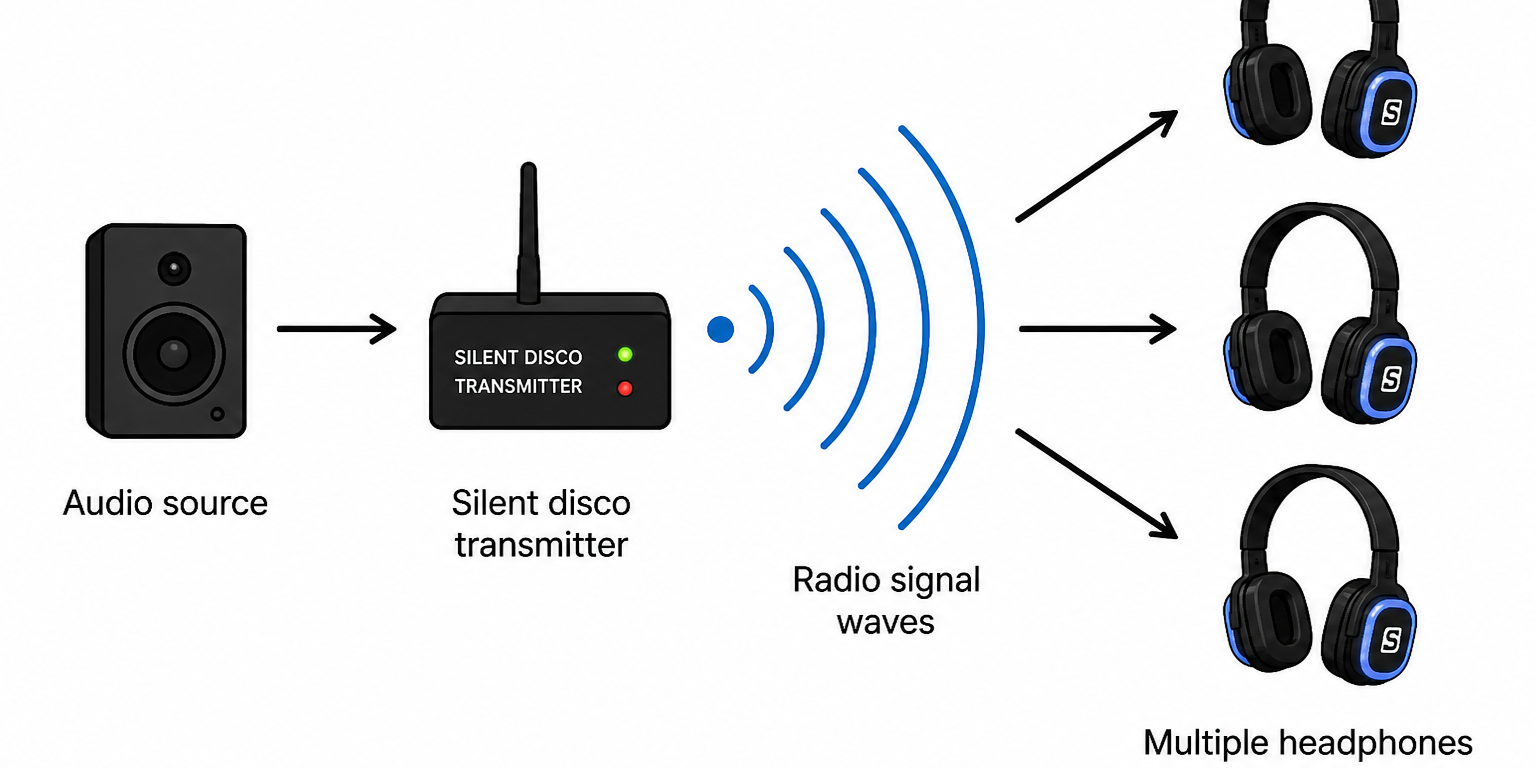
One of the most common misconceptions about silent discos is that the headphones connect via Bluetooth. It’s understandable — that’s how most wireless headphones work at home — but silent disco technology works quite differently, and once you understand the basic idea, it’s surprisingly simple.
Here’s the complete journey the music takes:
Audio source → Silent disco transmitter → Radio signal → Silent disco headphones
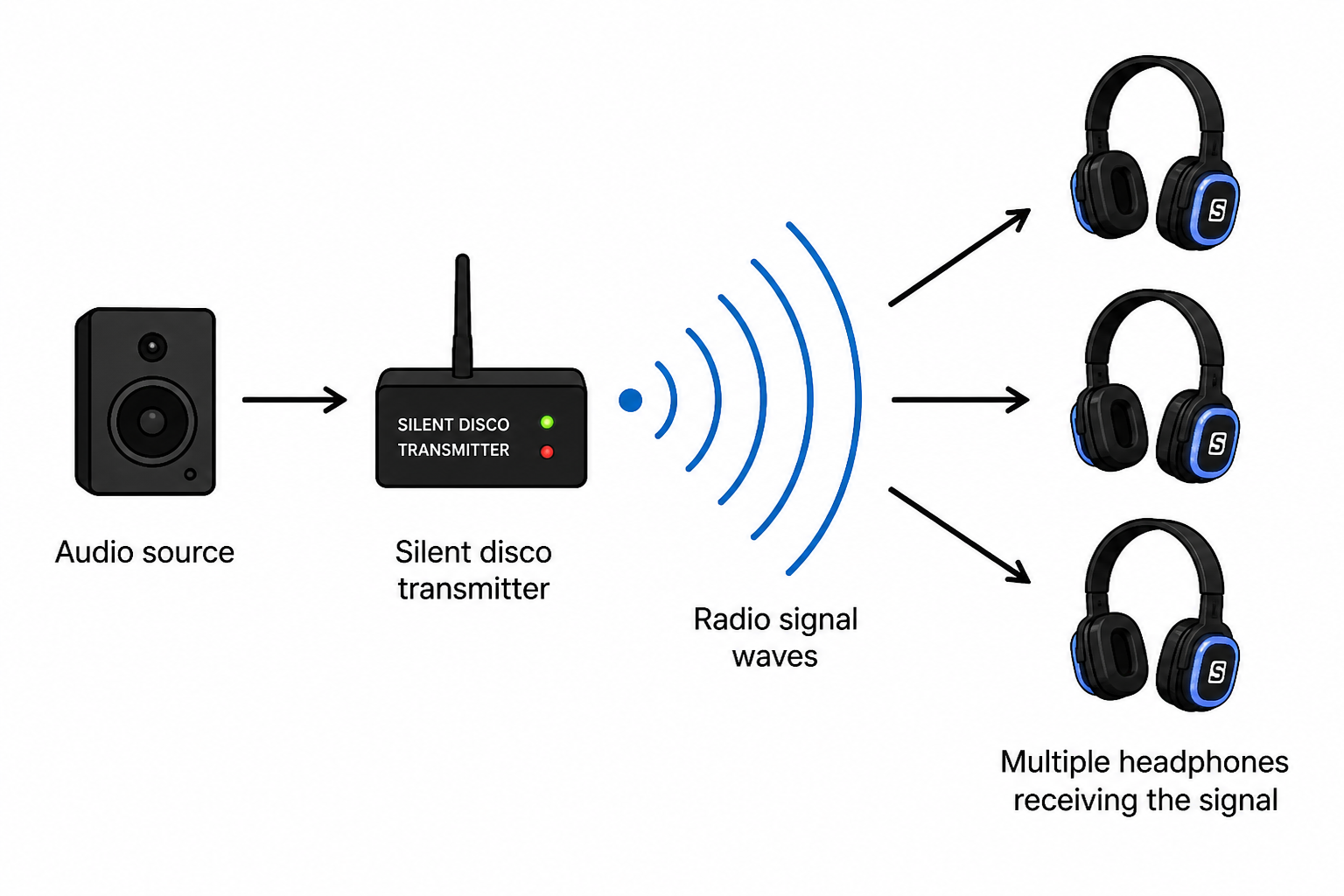
Think of it less like pairing a Bluetooth speaker and more like tuning into a radio station. A transmitter broadcasts audio on a set frequency, and every compatible pair of headphones within range picks it up automatically.
This guide explains each step of that journey — no technical background required.
Why silent disco headphones aren’t like Bluetooth headphones
Bluetooth is how most people use wireless headphones at home, so it’s the natural assumption — but a silent disco system works on a fundamentally different model.
Standard Bluetooth audio streaming is designed primarily for individual connections. When you pair your headphones to your phone, those two devices form a direct, private link. That works perfectly for personal listening, but it doesn’t scale to events.
Imagine a crowd of 100 guests. A standard Bluetooth audio transmitter can realistically stream to only one or two devices at once — some higher-end units manage a handful more, but nowhere near the numbers a silent disco requires. The technology simply isn’t built for mass simultaneous broadcast.
Silent disco systems take a different approach entirely. Rather than creating individual connections, they broadcast the audio signal — much like a radio station — and every compatible headphone within range receives it automatically. No pairing, no individual setup for each headset.
Key components: transmitter, headphones and audio source
A silent disco system has three main components: an audio source, a transmitter and the headphones. Understanding what each one does makes the whole system easy to follow.
The silent disco transmitter
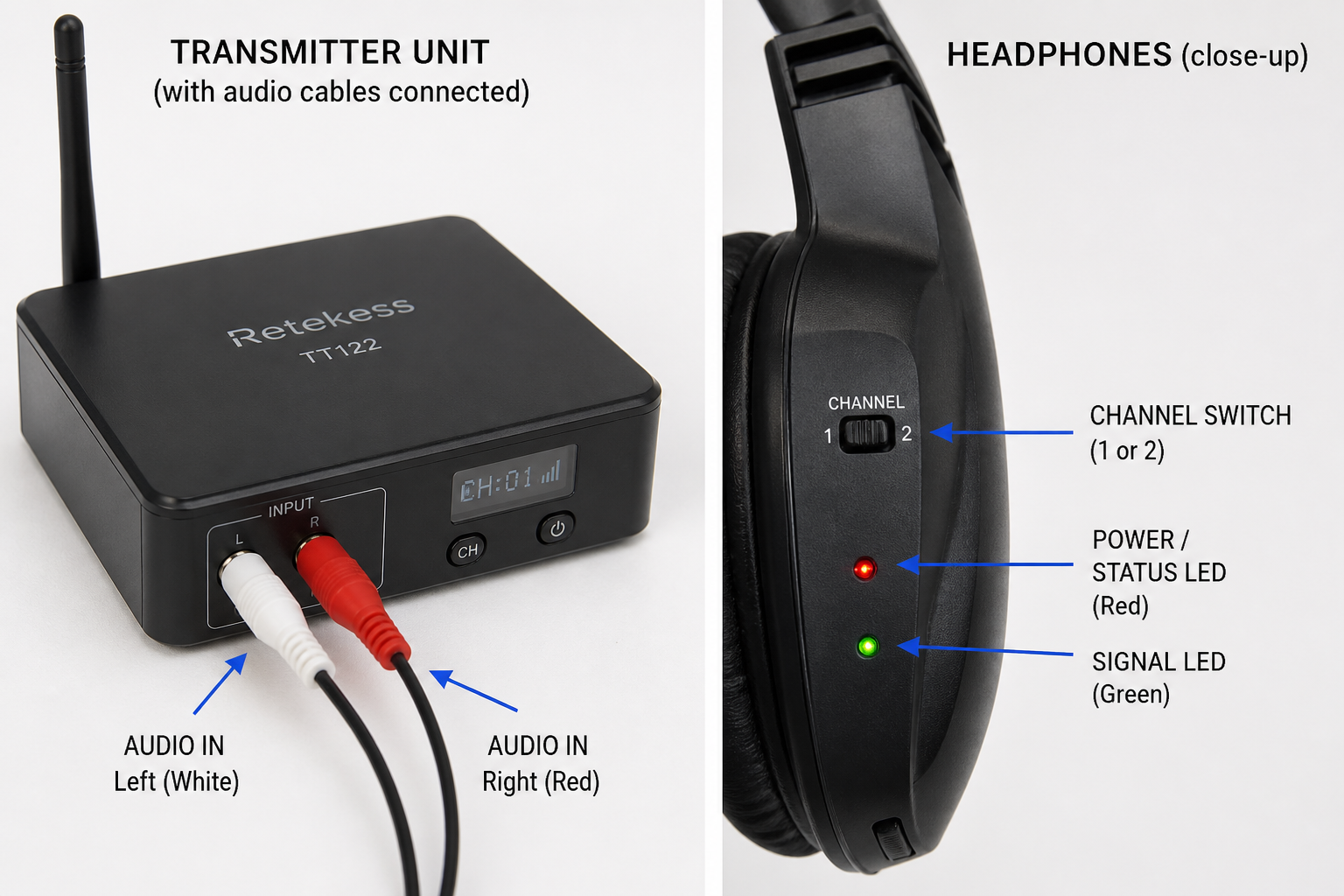
The transmitter is the heart of the system. Think of it as a miniature radio station — you connect your music source to it, and it broadcasts audio on its designated frequency. Any compatible silent disco headphone within range receives that broadcast automatically. The transmitter typically sits on a table or stand near the DJ or organiser, and most units are compact and straightforward to operate.
The silent disco headphones
The headphones contain a small receiver that picks up the transmitted signal. There’s no pairing process — they simply tune into the broadcast. Most silent disco headphones include a channel switch, usually a button or dial on the ear cup, letting the listener choose between available channels. LED lights on the headphones indicate which channel is selected, making it easy to see at a glance who is listening to what across a dance floor.
The audio source
The audio source is whatever is playing the music. It can be as simple as a mobile phone, tablet or laptop running a playlist, or a professional DJ mixer or controller. As long as the device has an audio output that connects to the transmitter — commonly via a 3.5mm jack or RCA cables — it can serve as the source.
If you’d rather leave the equipment setup to someone else, our silent disco hire service covers everything you need.
Think of it like a tiny radio station
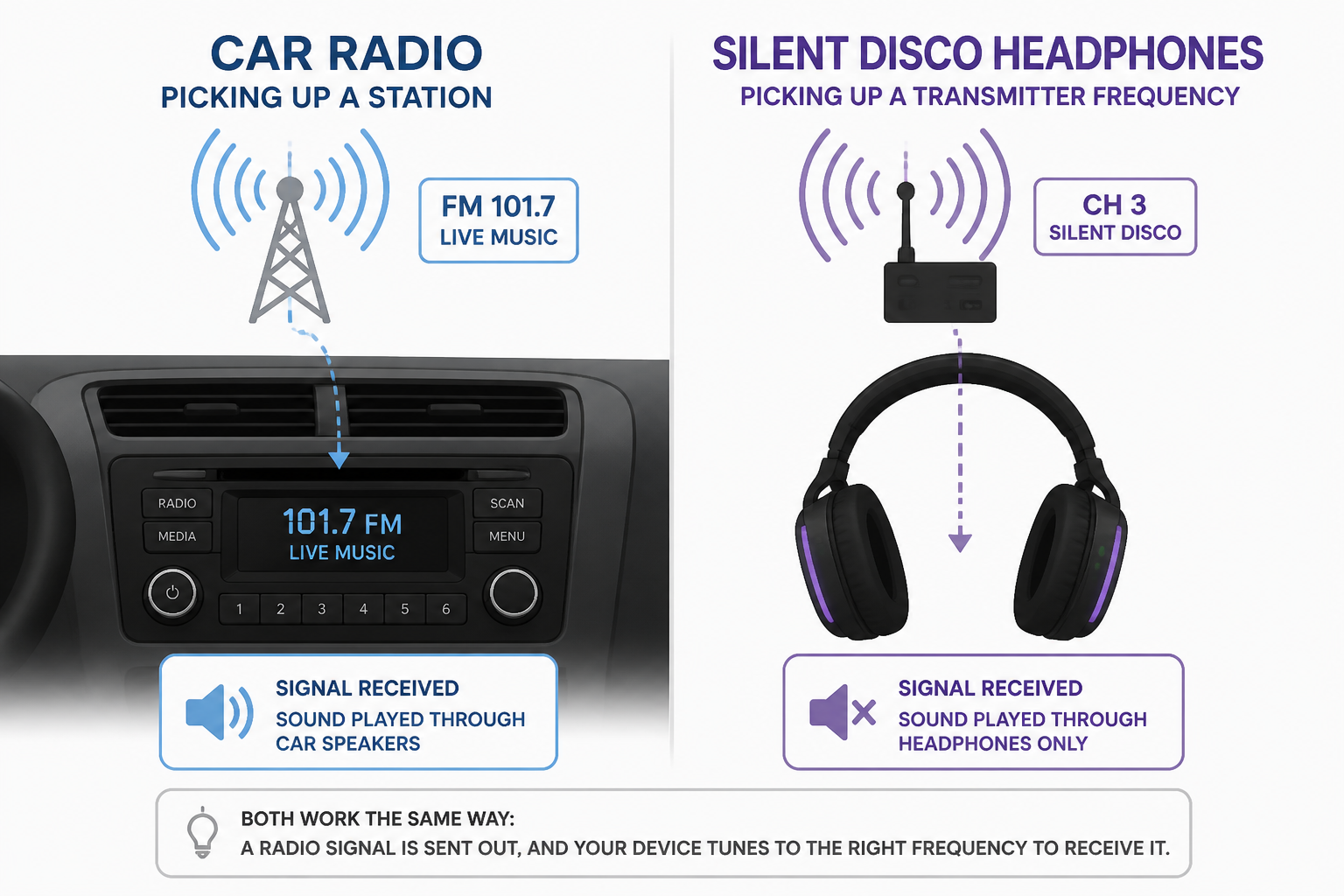
The easiest way to understand how silent disco works is to compare it to listening to the radio in your car.
A radio station broadcasts audio from a transmitter on a particular frequency. You tune your car radio to that frequency and it receives the broadcast. A silent disco works on exactly the same principle — just across a much shorter range, using equipment designed specifically for events.
One transmitter, broadcasting continuously, received by every headphone in range. The more guests you add, the more headphones receive the signal — the transmitter itself doesn’t change at all.
How multi-channel silent discos work
Many silent disco headphones support three channels, and systems with more channels are also available. The key thing to understand is that each channel is completely independent. You’re not splitting one audio feed into multiple streams — each channel has its own dedicated transmitter and its own audio source, each broadcasting on a different frequency simultaneously.
With a three-channel system, you might set it up like this:
- Channel 1 — pop and party anthems (playlist from a laptop)
- Channel 2 — rock and alternative (a second playlist or live DJ)
- Channel 3 — dance and electronic music (a third source or DJ)
To switch between channels, listeners press a button on their headphones. There’s no searching for a signal — all channels broadcast simultaneously, and the headphones jump between them instantly.
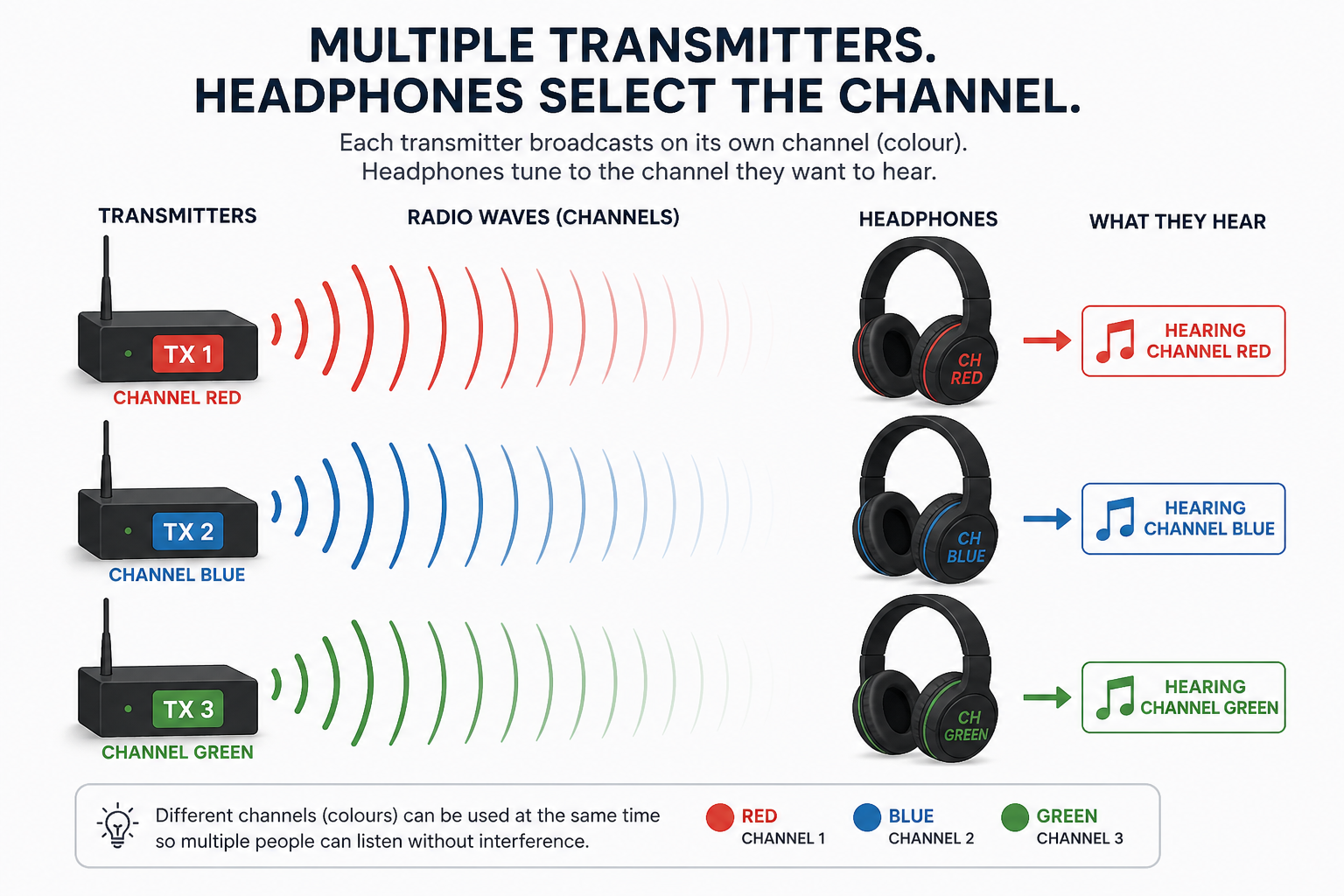
This is what makes multi-channel setups particularly enjoyable. You could have a DJ playing live on one channel, a completely different genre on another, and a curated playlist running on the third — all at the same time, in the same room. Everyone on the dance floor is potentially listening to something different, which creates that distinctive silent disco atmosphere.
Take a look at our three-channel silent disco hire options to explore what’s possible.
Setting up a silent disco: audio sources and a basic checklist
From the transmitter’s point of view, it doesn’t matter where the music is coming from — it simply needs an audio signal to broadcast. That can be a phone, tablet, laptop or a professional DJ mixer. As long as it has an audio output, it can work as your source.
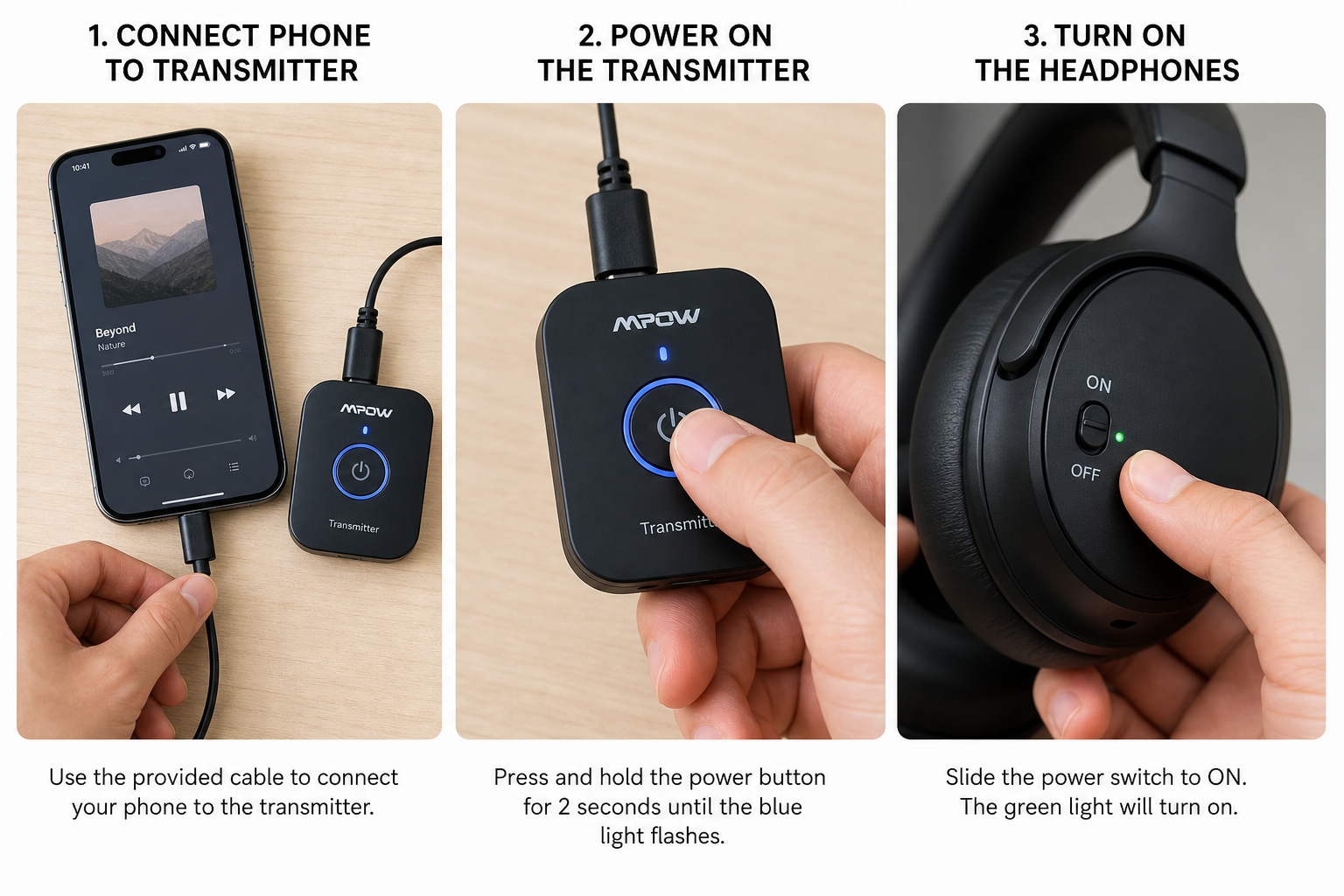
Here’s a basic setup checklist:
- Connect your audio source to the transmitter — typically via a 3.5mm jack or RCA cables, depending on your device and transmitter inputs.
- Power on the transmitter and check that the signal indicator confirms it’s broadcasting.
- Switch on the headphones — they should automatically detect the signal.
- Select the correct channel on each headset and confirm the audio is coming through clearly.
If something isn’t working, the most common culprits are loose cables, input levels set too low on the source device, or the transmitter not being powered correctly — worth checking those first before anything else.
Prefer to leave the setup to someone else? We can supply and set up equipment for your event.
Transmission range and legal considerations in the UK
Silent disco transmitters operate over a much shorter distance than commercial radio stations. The exact range depends on the transmitter’s power output and the environment — walls, crowds and other obstacles can all reduce it — but most professional equipment is well suited to typical event spaces such as halls, marquees and open fields.
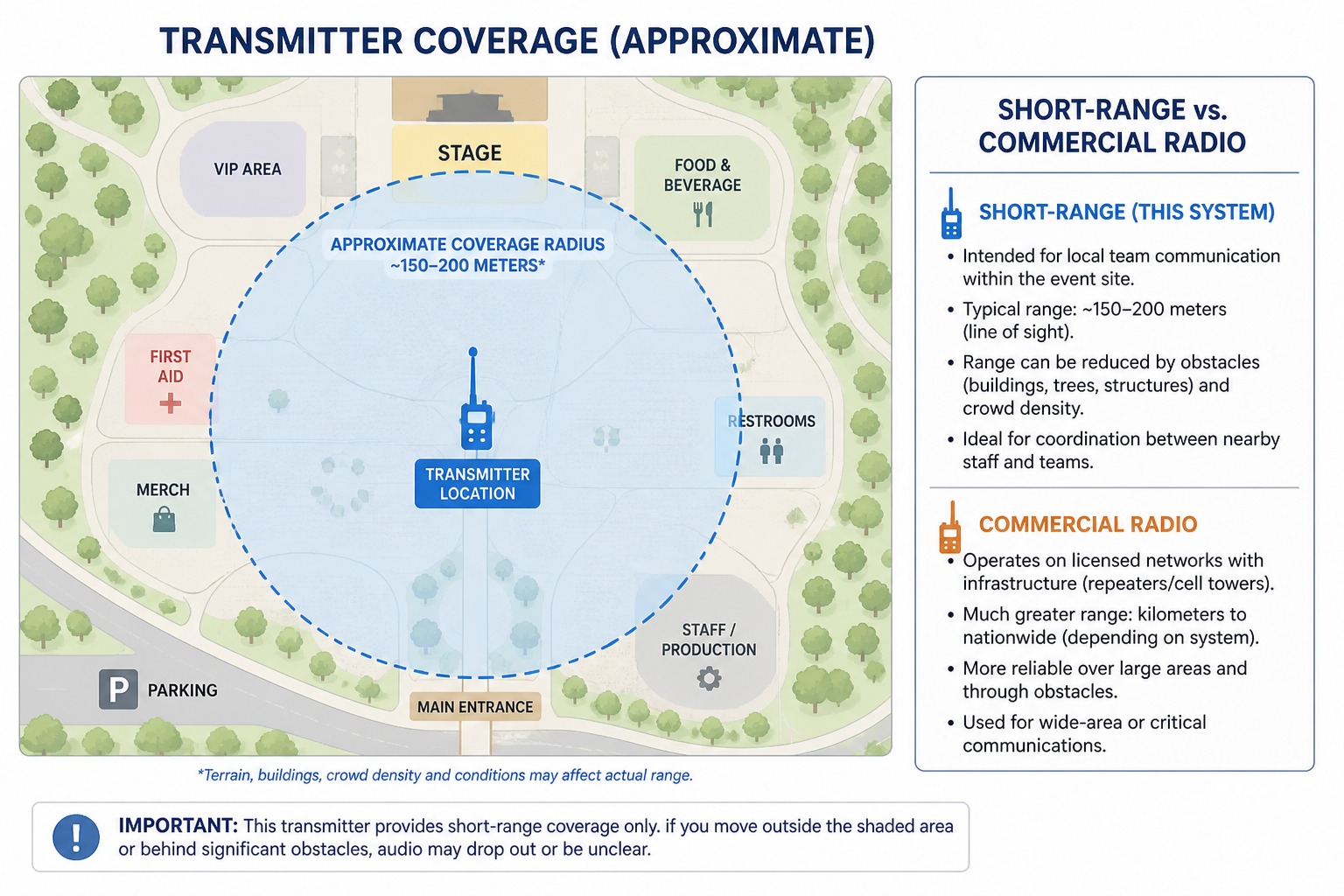
On the legal side, radio frequencies aren’t a free-for-all. In the UK, compliant silent disco equipment can operate on licence-exempt frequencies — meaning no separate broadcasting licence is required for standard event use, provided the equipment meets the relevant technical specifications for short-range devices. This is governed by Ofcom’s framework for short-range devices, and applies to equipment operating within permitted power limits on appropriate frequency bands.
If you’re organising an event outside the UK, check the rules that apply in your country before the event, as regulations differ.
Interference, signal quality and how to prevent problems
People sometimes worry about interference — whether they might suddenly hear someone else’s transmission through their headphones. With modern silent disco equipment set up and operated correctly, this generally isn’t a problem in practice.
Modern systems use technologies such as channel separation and, in many cases, digital transmission to reduce the risk of unwanted signals getting through. That said, no wireless system is entirely immune. Signal quality can be affected by pushing beyond the transmitter’s intended range, significant physical obstructions, or other wireless equipment operating nearby on similar frequencies.
If you do notice signal degradation, the practical fixes are straightforward: reposition the transmitter to a more central location, reduce obstructions between the transmitter and headphones, and ensure the equipment is operating on the correct, compliant frequencies for your venue.
Why silent discos scale easily to hundreds of headphones
The broadcast model is what makes scaling a silent disco so straightforward. The transmitter isn’t connecting to each headphone individually — it broadcasts continuously, and every compatible headphone within range receives that signal. Adding more headphones doesn’t change the setup at all.

You switch the headphones on and they receive the broadcast — whether there are 20 headsets or 500. For very large events spread across a wide area, organisers may need additional transmitters to ensure full coverage, similar to how a building might use multiple Wi-Fi access points. But the core operation remains the same: one broadcast, received by many.
Choosing silent disco equipment: practical tips for organisers
Modern silent disco systems are straightforward to operate, but choosing the right equipment for your event does require some thought.
What to consider when selecting kit
- Number of channels — do you want one genre or three? More channels mean more transmitters and audio sources.
- Headphone battery life — check how long the headsets last on a full charge and whether that comfortably covers your event duration.
- Transmitter range and power — make sure it suits your venue size; larger or outdoor spaces may need more powerful transmitters.
- Digital vs analogue transmission — digital systems generally offer better channel separation and signal reliability.
- Headset comfort and durability — especially relevant for longer events where guests will be wearing them for hours.
On-the-day essentials
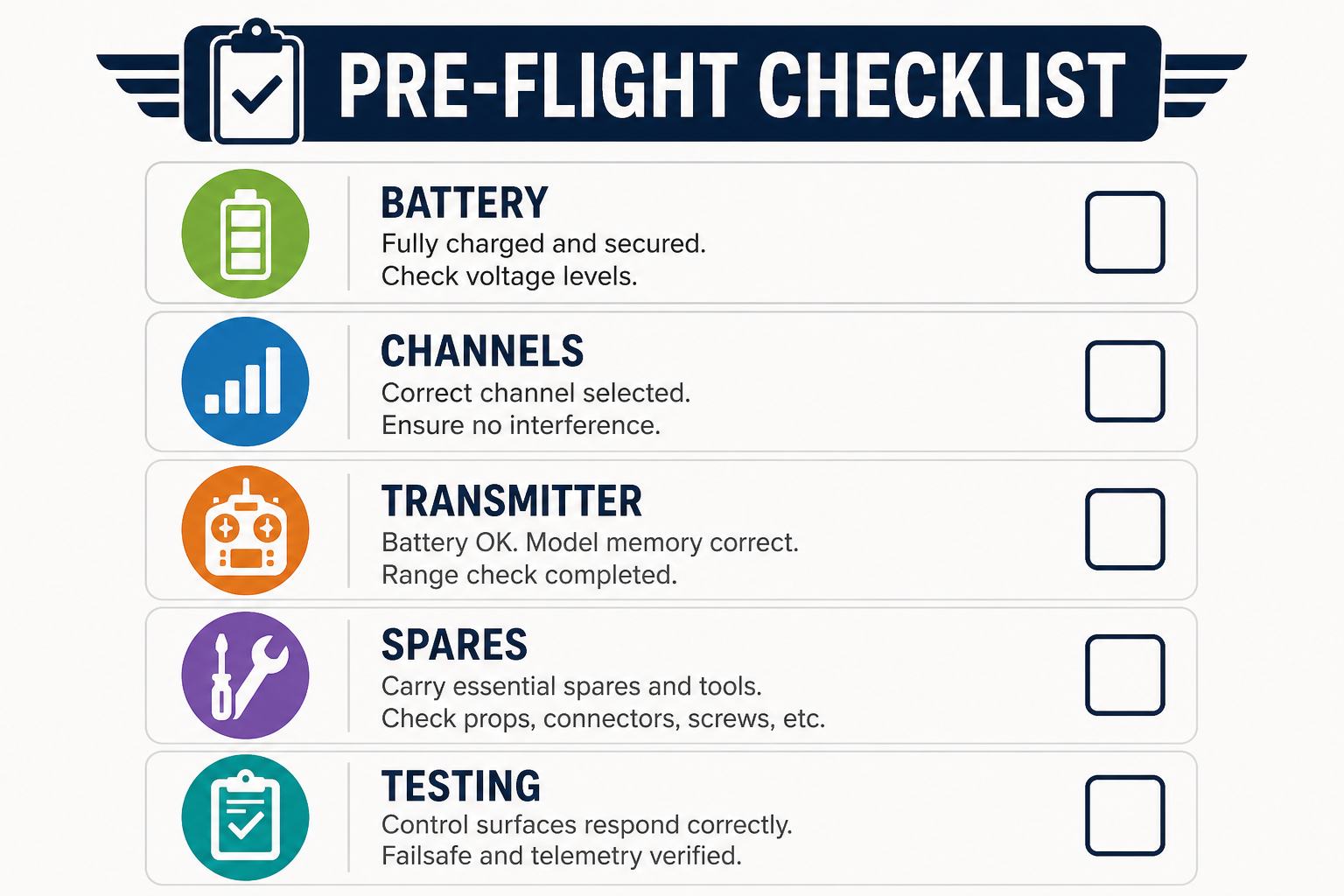
- Test the full system before guests arrive — check audio levels, headphone reception and channel switching.
- Keep a spare battery pack or backup audio source available in case something fails mid-event.
- Plan your headphone handout and return process, particularly for larger events where queues can build quickly.
- Assign someone to troubleshoot headphone issues so the DJ or music source isn’t interrupted.
If you’d rather not manage the equipment logistics yourself, the easier option is to hire silent disco equipment from an experienced supplier. Or if you have specific questions about your event setup, feel free to contact us for tailored advice.
Common questions about how silent disco works
Can people talk to each other while wearing the headphones?
Yes. Some headphones include a monitor mode that lets ambient sound in; otherwise, guests simply lift or remove their headphones to have a conversation.
Will I hear other radio stations through the headphones?
Unlikely with modern, properly set-up equipment. Interference isn’t completely impossible — a particularly busy RF environment or operating beyond the transmitter’s intended range can occasionally affect signal quality — but it’s rarely an issue in practice.
How many channels can I have?
Three channels is the most common standard setup, giving you three simultaneous music options. More advanced equipment can support additional channels if needed.
Do I need a broadcasting licence in the UK?
In the UK, compliant silent disco equipment can operate on licence-exempt frequencies, so no separate licence is required for standard event use. Always ensure the equipment you’re using meets the relevant specifications, and check local rules if you’re organising an event outside the UK.
Have a question not covered here? Ask us and we’ll point you in the right direction.
The simple version
At its core, a silent disco follows a simple path: audio source → transmitter → radio signal → headphones. The technology happens in the background, which is exactly why it scales so well. Whether you have 20 guests or 2,000, the broadcast model means every headphone receives the signal without individual pairing. Add more channels, add more transmitters, and the same principle applies throughout.
If you’re planning an event and want professional equipment without the hassle of sourcing and configuring it yourself, we can help. See our silent disco hire options to find the right setup for your event, or contact The Silent Disco Guys if you have specific questions and want tailored advice.